Showing posts with label ogre3d. Show all posts

Monday, January 3, 2011

Changes in Hardwar development

Possible Hardwar main menu scene

Hardwar is a long-term project to remake the 1998 Hardwar - a science fiction flight simulation game. There have been two recent changes:

The code hosting switched from Launchpad's bazaar to GitHub.

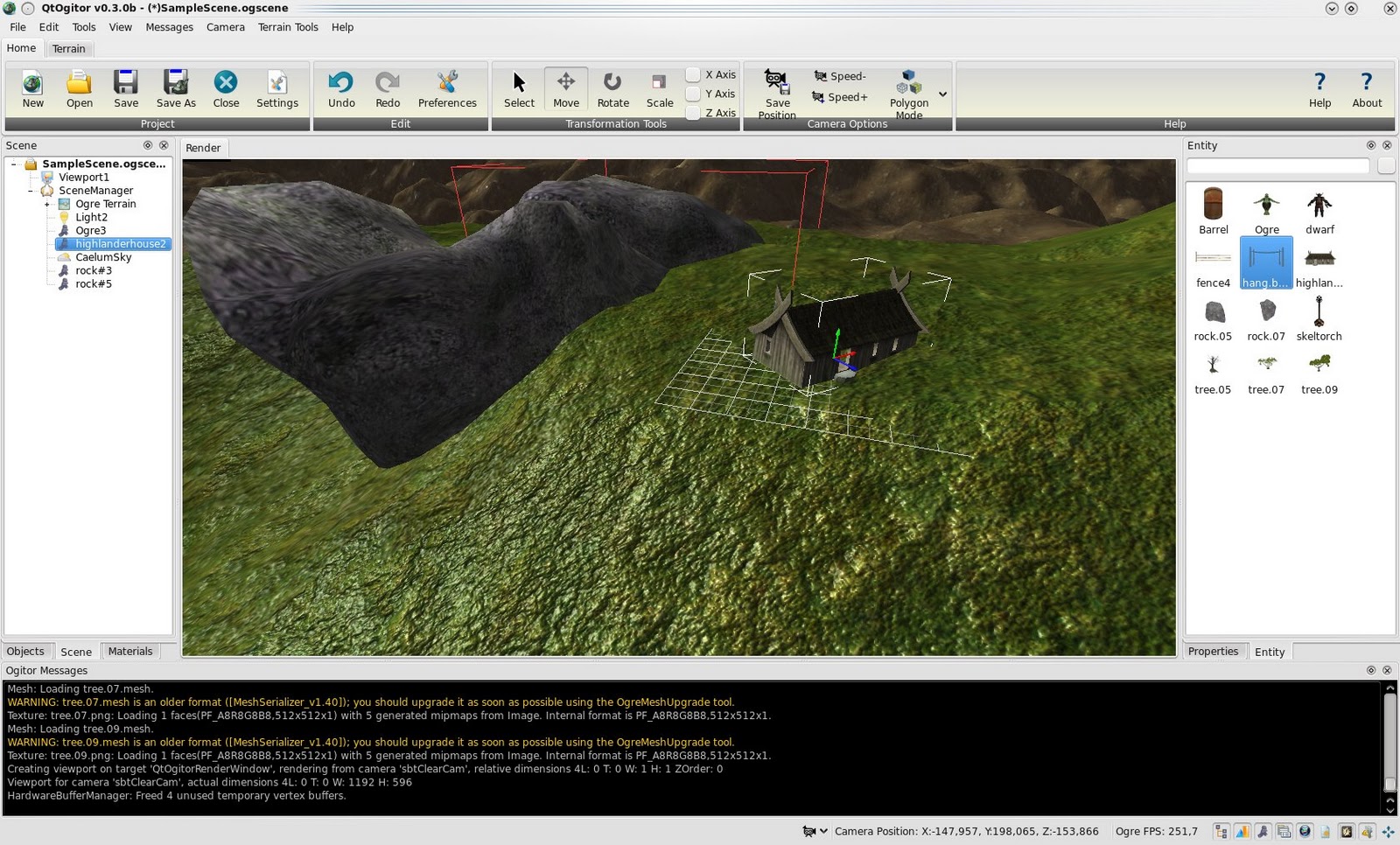
The in-game editor was dropped and instead Ogitor will be used. While in-game editing is awesome, I'm glad that a general tool is being used and time is being saved.

Ogitor 0.3

Ogitor is a Plug-In based WYSIWYG editor environment for OGRE.

OGRE is on a hunt for illogic in its API as a preparation for releasing 1.8 and every coder is invited!

Saturday, January 1, 2011

OGRE3D History: 2010

There's a retrospective of 2010 post on OGRE's blog. Here are some interesting FOSS projects they mentioned:

Project Name Type License Description
Gorilla Library     MIT GUI library
Hovercraft Game GPL* Racing *Depends on non-free fmod, havok and zoidcom
Island Hopping      Game WTFPL*     Platformer *Depends on non-free irrklang
MOGRE Library MIT Bindings for .NET
OgreKinect Library MIT Input library for Kinect
OgreProcedural Library MIT Procedural geometry library
OpenSpace3D Tool LGPL* Scene Editor *Depends (?) on non-free newton physics
QuickGUI Library LGPL GUI library
Spacescape Tool MIT Create space skyboxes with stars and nebulas
Zen Engine Library ZLib 3D game engine client framework


Spacescape running in Wine

I wasn't able to build Spacescape SVN but the 0.3 release runs fine in Wine.

Island Hopping's game over screen

Island Hopping's dependency on irrklang is probably easy to replace, so I gave it a try using Wine with success (broken sound though, go figure).


OpenSpace3D wouldn't start in wine and I don't know if it's build-able on Linux.

PS: Statistics!

Friday, February 5, 2010

Open Source 3D Game Engines Updates

Crystal Space 1.4 is out. Features include improved animations ("integrating vertex based animation with skeletal animation") and terrain ("improves rendering and handling of large outdoor areas"), OpenAL for sound and an internationalization plug-in.


Engine screenshots are very informative. This is Panda3D by the way.

Panda3D has a prettier website, it released version 1.7.0 and apparently has a web-plug in. The new version makes it easier to crash the computer, but also gives a performance boost - with the magic of 'pointer textures'.


I have a little crush on Panda3D, because it gives access to 3D and audio with no complicated setting up through a scripting language (Python). On the other hand it requires 3D models to be in its own format and I find converting not very convenient. For example there have been problems importing animations into Radakan.


OGRE mascot

Ogre has a mascot, and it might even become freely licensed, somebody just needs to confirm this (by posting in the thread). :)


Besides that, 1.7.0 RC1 has been released, which is licensed under MIT license (before, it was LGPL). Here's what seems like a changelog.


OGRE wikis
Furthermore, the OGRE wiki moves from MediaWiki to TikiWiki. I suspect that a main reason is because a nicer OGRE style was made for TikiWiki, while the MediaWiki OGRE style looks bad. That may be a strange reason, but as long as it makes people use the wiki more, why not? Here's the discussion if you have an idea.


Just for kicks: a simple comparison of OGRE, Panda and Crystal regarding lines of code. What does it tell us? Well, that OGRE has the biggest codebase (even though it only handles graphics), that Panda3D is the most compact of the tree and that Crystal Space code size had strange ups and downs. Nothing more really.


Kambi VRML v2.0 is soon to be released, as is the final version of the demo game Castle (which will only mean additional eye candy to the game). What is more important, as soon as Castle 1.0 is released, work will start on Castle 2.


Castle 1 is a three-level game and I consider it hard (easy to die) and its controls to be rough. On the other hand the level design is great: the layout invites exploration the levels are linear, each with a goal to be reached. This way the levels actually are part of a game, rather than an open-ended tech demo. This is why I have a good feeling about Castle 2.0 already. Depending on whether the developers decide to work on Castle 2 on their own or to ask the community for contributions, we might see some more use of their forum.


Morrowind scroll loaded in OpenMW
OpenMW, the Morrowind engine implementation in OGRE switched from D to C++ (because of compiler availability and language popularity) and from svn+git to git-only (because of git-svn problems). Git clone instructions here. The next feature to be implemented are animations. A video was promised as soon as they are ready.


Old news: OpenGameEngine development stopped in October 2009, until a project manager wants to take over. The form in which the project is left is described as "usable" and "still too much work to make it worth the time investment".


Enjoy another ridiculous comparison of 3D (game) engines: OpenMW, KambiVRML and OGE. I just love diagrams. :)


We have a list of 3D engines on our wiki, if you want to dig some more. Also all FOSS game engine blogs that have feeds are included in the FGD development planet feed aggregator.

Thursday, November 13, 2008

Open Source Game Engines Updates

OGRE 1.6.0 aka Shoggoth is the newest version of the acclaimed 3D engine. I don't understand anything that's on the changelog, but it obviously goes beyond bugfixing and tweaking. :)


There are no recent pre-compiled packages available, so the source way is the way to go, for now.


The Infinity Engine's clone GemRB had some DONEs added to it's TODO, when version 0.3.1 was released a month ago.


OpenMW, an OGRE-based engine for TES3's game data, is now 0.5-versioned. Considering that the project started in this year's june, this number is quite impressive! Does this mean that we will have a final version of OpenMW by the start of 2009's summer? :D


However, animations, interaction and user interface are not yet implemented. Also: check out these videos that show the progress of the engine so far.


cocos2d-iphone is yet another LGPL-ed game framework and you can probably guess the platform it's designed for :). However, freedom freaks will argue that free software can not exist on an iPhone.


Ignoring all that, I find the Video presentation of the engine very spiffy. It demonstrates all the features in a more entertaining way than the raw text listing over here.


The Kambi VRML game engine now contains a demo of Precomputed Radiance Transfer. It has something to do with real-time lighting I think.

Wednesday, September 17, 2008

English transcription of "Hobby Game Development" (neues, 3sat)

Narrator: On first sight it looks like the commercial online role-playing game Ultima Online. On the second the viewer might spot one or another change. Maybe even something special, which doesn't even exist in the original game.


This game is named Iris 2, built on top of Ultima Online and is freely available online. It was developed by hobby game developers.


It's their hobby, just like others knit pullovers in the evening. Florian Fischer and Iwan Gabovitch develop games in their free time. What's the thrill of developing games on your own?


Florian: It's just fun to be creative and to express this creativity. Games are super for that.


Iwan: First I stopped playing commercial games and started searching for new, interesting games. I found many freeware games and then came across the open source scene, where also games get developed, where
it's easy to contribute, without having to get involved too much.


Narrator: Most developers are not professionals but they have lots of potential and ideas, which they want to share and to put into practice with others.


Free software is being used, which is available gratis online. For example to create graphics of special effects.


For the 3D visualization, Florian works with OGRE. OGRE is open source software, which can be copied, distributed and used without limitation. Working with free software excites the developers.


Florian: Others can download our code, can compile games on their own, can try own things and can improve the programm. The principle of open source is nice: I give something and, as I use open source tools, I also take something.


Narrator: Usually each developer works seperately on his computer but once a year the hobby developers meet live.


The event Dusmania was initiated so that developers could exchange experience, but of course there has to be some actual development too. In nine hours, they had to develop a game. The group of Iwan and Florian created "lalalove", a game in which sounds have to be generated to make people happy.


Iwan was responsible for the graphics in lalalove. First he sketches the images, before layouting them on the PC.


Somebody who invests so much love and free time into game development could work for commercial game producers, but this doesn't interest the community.


Florian: We don't have to follow any rules, we can implement every idea and we can throw it out too. We can be as creative as we want to be and this is fun. We can create prototypes of games and then say "we like this game principle" or maybe someone else in the community likes it and develops it thurther. I find this freedom fascinating.


Narrator: One who wants to experience developing games on his/her own, finds a lot of tips on the web. Beginners are also able to get into the scene easily.


Free Gamer is an online community for hobby game developers. It consists of a blog, a forum and a wiki. The forum is for discussions. On the wiki articles can be published and freely edited. For example there is a list of open source 3D game engines, which everyone can use for his own games.


If someone prefers to play rather than develop, won't be disappointed. Games of all sorts are available on the net. For example the cute SuperTuxKart. Instead of Mario, a penguin drives against the tree.


End of transcription. Please not that all text by the Narrator is not freely licensed and it's copyright is owned by 3sat.


Please note that simplification and generalization are unavoidable if you want to squeeze a topic into four minutes. There are of course people who are interested in commercial application of open source and there are open source game developers who would like to work in non-free, commercial game developer companies.

Sunday, January 27, 2008

The early bird

The early bird has to wait for the worm. And when he wanders off a bit bored, he gets back to find some other bird has poached the worm and his morning was fruitless. So, there you have it, you may as well lie in.


There's an update to Battle for Antargis, version 0.2.1.5 which is labelled a "developer release". The build system has been overhauled so the game should be easier to build. There have been improvements to the game too and the next version should be the first Antargis release to feature a storyline. I really like this project, Godrin is creating an entirely original game that doesn't conform to any particular standard mold.


Bos Wars pre2.5 is available for download. Improved graphics with beautiful particle explosions, new maps, and bug fixes. Sounds like this project is galvanising now that the developers don't have to focus on separate Stratagus releases.


Nimuh 1.0, "searching for the andalusian treasure". Interesting looking isometric puzzle game. I don't think the game data is open source but it looks like the engine is and the game is still free to download as a whole so, well, it depends on how ideological you are.


I came across an interesting site that seems to be collecting [links to] downloads for open source Linux games. It seems to be mostly Suse entries, probably saying more about the people responsible for the site than the fact that Suse is the most popular distro. Ubuntuers can always go to GetDeb for a few game options.


Want awesome 3D effects? FXExpression is an LGPL library for Ogre3D. Maybe you don't use Ogre3D but it's LGPL so surely some of it can be ported. Got some cool looking effects there.

Wednesday, June 27, 2007

Sauerbraten, Vega Strike, Project Kilo

Did I not mention this Sauerbraten update? I don't recall doing so, and I swear it was not a thread in their forum at the weekend despite being listed as posted on the 12th June. Anyway... it fixes a whole lot of bugs, adds graphical enhancements, and cleans up scripting support a little. Probably more of an update for people making mods/games with Sauer than players but, shucks, I love this project. Embarrassingly this was a 2006 release... *oops*


There's the possibility of a StarShip Troopers: Last Defense, the Glest mod, becoming available for FreeBSD.


The Java Classic RPG project has posted a snapshot for anybody who wants to play with it in it's very early stages of development. Work continues at an impressively frantic pace, soldiering away on features. Hopefully a modeller or two can start contributing to the project to make the artwork updates as impressive as those to the codebase.


I keep pestering the Vega Strike team to make a new release. I, and others, frequently get pointed to the SVN version. However it turns out that there is a Windows build of the executable made every few weeks, although you will still need a subversion client to get the latest version of the game data.


Talking of pestering projects, I'm trying to convince the Project Kilo guys to use Sauerbraten as their game engine. Project Kilo is an effort (well, currenlty mostly an idea) to create an immersive single player 3D RPG game. Sauer is the engine also behind the Eisenstern project, another 3D single player RPG effort with slightly less lofty (but still impressive) goals than Kilo.


Eisenstern


The main feature of Sauer is in-game multiplayer map editing where all map elements are defined as cubes or combinations of cubes, it makes a lot of sense to map modellers. I think the combined nature of Sauer's very easy map creation and it's development supporting Eisenstern makes it really suitable for, at the very least, prototyping a concept like Project Kilo. With little or no code the Kilo team can be up and running in no-time, and (being open source) they can build additional features into Sauer as they require them and possibly even feed back upstream. I think it's a far more pragmatic route than taking an engine like Crystal Space or OGRE3D and creating the game logic from scratch. Map modelling itself will become far more of a burden using this approach, let alone the extra effort to make a playable scenario.


I'm not saying that Crystal Space and OGRE3D don't have their place in development - they are important game creation tools - but if somebody has done 95% of the work for you like the Sauer team has, by implementing a game [engine] that not only makes map modelling easy but lets you roam around massive maps with fancy effects and is easy to customize, then surely it makes sense to start there instead of starting far behind them.


People should do as I command suggest because I am always usually right. ;-)

Blog Archive